
Chore Chart App for Kids With ADHD: What Actually Works
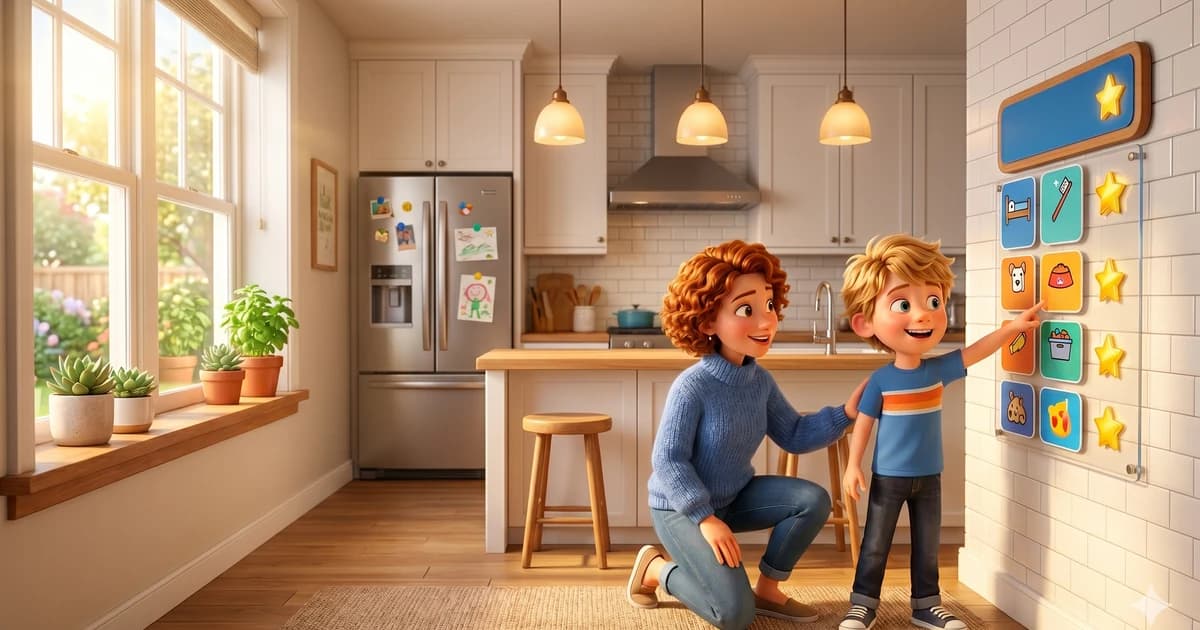
You bought the laminated chart. You printed the cute template off Pinterest. For about four days it worked, and then it became another thing on the fridge nobody looked at — including you. If you're parenting a kid with ADHD, you've probably run this experiment more than once.
The problem usually isn't your kid, and it definitely isn't you. It's that most chore systems are built for a brain that finds "do it now, feel good about it next week" motivating. The ADHD brain doesn't work that way — and once you understand the why, the right approach (and the right app) gets a lot clearer.
This guide covers why standard chore charts fail kids with ADHD, the principles that actually make a routine stick, what to look for in a chore app, and a few apps worth trying. We make a family app ourselves, and we'll be upfront about where it is in the end. But most of this you can put to work today with whatever you already have.
Why standard chore charts fail the ADHD brain
Three things are usually working against you. None of them are character flaws.
The reward is too far away. ADHD brains tend to weight an immediate reward heavily and a distant one far less — a pattern researchers have measured again and again. "Allowance on Sunday" is, to a Tuesday brain, basically theoretical — the motivation to act now just isn't there.
"Clean your room" is not one task. To an ADHD kid, "clean your room" is a wall of fog: pick up clothes, make the bed, clear the desk, deal with whatever's under the bed — where do you even start? Faced with a vague, multi-step instruction, the brain stalls. That stall looks like defiance or laziness from the outside. It's usually just overwhelm.
The chart is out of sight, so it's out of mind. "Out of sight, out of mind" is close to a literal description of how ADHD affects working memory — the mental sticky-note that holds onto what you're supposed to be doing right now. A paper chart on the fridge requires your kid to remember to go look at the thing that reminds them what to do. That's the exact loop ADHD makes hard.
Put those together and the laminated chart never had a chance. The fix isn't more discipline. It's designing around how the brain actually works.
5 principles that actually make a routine stick
These work with a paper chart, a whiteboard, or an app. The app just makes them easier to keep up.
1. Make the reward immediate and visible
Shrink the gap between "did the thing" and "got something for it." A point that lands the second the task is done — that the kid can watch tick up in real time — beats a far-off payday every time. The reward doesn't have to be money. Points toward a Saturday privilege, a streak they don't want to break, a level-up — anything concrete and now.
2. Break tasks down until they're impossible to misread
Don't write "clean your room." Write "1) clothes in the hamper, 2) books on the shelf, 3) bed made." Three checkboxes a kid can knock out beat one vague command that triggers a stall. Specific beats big. If a task still causes a freeze, it isn't broken down far enough yet.
3. Put the routine where they'll actually see it
The list has to live where your kid already looks — which, let's be honest, is a screen. This is the single biggest advantage an app has over the fridge: a phone or tablet sends the reminder to them, instead of waiting for them to remember to check a piece of paper. The right notification at the right moment does the remembering so their working memory doesn't have to.
4. Celebrate effort, not perfection
This one matters more for ADHD kids than almost any other. They get corrected a lot — at school, at home, by themselves. A system that only pays out for a perfect week, and resets the streak the first time they slip, just becomes one more place they feel like they're failing. Reward the attempt. Let a missed day be a missed day, not a reason to wipe the slate. Momentum is the whole point, and momentum survives an off day far better than it survives a reset to zero.
5. Make it the same every day
Novelty is catnip to the ADHD brain — which is exactly why your routine shouldn't rely on it. Same tasks, same order, same time, so the sequence eventually runs on autopilot and stops costing a decision every single morning. Save the novelty for the rewards, where a little surprise is a feature. Keep it out of the structure, where it's friction.
What to look for in a chore app for ADHD
If you're going to use an app, these are the features that map to the principles above — and the ones generic "best chore app" lists tend to skip.
- Instant feedback. Points, stars, or a visible level that updates the moment a task is checked off. Immediate, not end-of-week.
- Subtasks / checklists. The ability to break one chore into a short ordered list of steps, so "clean your room" becomes three small wins.
- Smart reminders. Notifications that go to your kid's device at the right time — the app does the remembering.
- A progression they care about. Levels, streaks, quests, an avatar that grows — a reason to come back that feels like a game, not homework. (For a lot of ADHD kids, this is the difference between using it and ignoring it.)
- Effort-friendly streaks. A streak that rewards showing up, and ideally a built-in grace day, instead of punishing a single miss.
- Real allowance tracking (if you tie chores to money). Watching earnings add up is itself an immediate, visible reward — and it teaches something real along the way.
A few apps in this space are worth a look today: Joon builds chores around caring for a virtual pet and is popular with ADHD families; Habitica turns tasks into a retro role-playing game and works well for older kids who like that style; and Goally focuses on visual routines and is often used by neurodivergent families. Try one against the checklist above and see what your kid actually responds to — fit matters more than features.
Where FamHero fits — and the honest part
We're building FamHero around exactly the principles in this post, because the "whole family won't use it" problem and the "ADHD kid won't stick with it" problem turn out to be the same problem: the app has to be something a kid genuinely wants to open.
So FamHero is built so kids earn stars, level up, run quests, keep streaks, and track real allowance — with the chores, calendar, meals, and grocery list for the whole household in one place, instead of a separate app for each. Tasks break into steps. Rewards land immediately. Streaks reward effort.
Here's the honest part: FamHero isn't available to download yet. We're pre-launch, close to release but not there. So we're not going to tell you it's the answer to this week's chore battle — it can't be yet, and we'd rather be straight with you than oversell.
What we'd ask instead: if a kid who won't stick with a routine is the thing wearing you down, join the waitlist and we'll email you the day FamHero goes live — nothing in between. When it launches, you'll get a 14-day free Pro trial with no credit card required, so you can find out whether your kid actually keeps a streak before you pay anything.
Until then, you don't need us to start. Pick two principles from above — say, immediate rewards and breaking tasks into steps — and try them this week with whatever chart or app you've already got. The goal was never a perfect system. It was a kid who feels good about helping, even on an imperfect day. That part you can start tonight.